
Long before forests covered the earth, the birds sang in the trees, and dinosaurs walked on the planet, something strange towered over ancient landscapes. This organism called Prototaxites went extinct before the human eye had the chance to behold it. Judging by the fossils first discovered in 1859, scientists speculated that it looked like a trunk and could grow several meters tall. Research aimed at uncovering what comprised this enigmatic organism has gone on for centuries; yet, our understanding is far from being complete.
Prototaxites lived roughly 420 million years ago, during the Silurian and Devonian periods, at a time when plants had just begun colonizing terrestrial environments. Long before forests as we know them existed, these towering organisms dominated early terrestrial landscapes. Some fossils suggest that Prototaxites may have reached up to 8 meters in height, making it one of the largest, if not the largest, organisms of its time.
Prototaxite fossils have been recovered across several continents. They were geographically widespread. Evidence also indicates that certain animals like arthropods fed on them. Together, these findings point to their crucial ecological role during terrestrialization.
Despite increasing research, determining what group of species Prototaxites belongs to has been challenging. Scientists have proposed nearly every possible identity for them. Their complexity reveals eukaryotic structure; but the possibility of Prototaxites being algal groups or plants has been ruled out. Chemical analyses also showed that Prototaxis was a heterotroph rather than a photosynthesizer. In light of this finding, many suggested that they derive energy through a lichen-style symbiosis with a photobiont. The idea gained support when Retallack and Landing (2014) described a nearly nine-meter Prototaxis fossil with branching structures and concluded that the organism was indeed a lichen. But no compelling evidence of a photobiont population has been found to date.
Later came the work of Honegger, Edwards, Axe, and StrulluDerrien (2018), who examined a Protoaxis fossil using light and electron microscopy. They observed features associated with Ascomycota, which strengthened the fungal interpretation and suggested that Prototaxites might represent an early, now vanished branch of the ascomycete tree. But of course, as with the previous hypotheses regarding Prototaxis’ identity, certain factors call the fungal interpretation into question, such as scanty anatomical similarity. Prototaxites are composed of interwoven tubes just like fungi, though the structure of the tubes does not match any known fungal architecture. The tubes inside Prototaxites branched wildly and presented a more convoluted structure, whereas the threadlike hyphae in modern fungi follow more orderly patterns. More importantly, the researchers detected no chemical trace of chitin, which is an essential component of cell walls of all living fungi.
Below are images of fossils collected and a speculative visual of what Protoxis looked like.
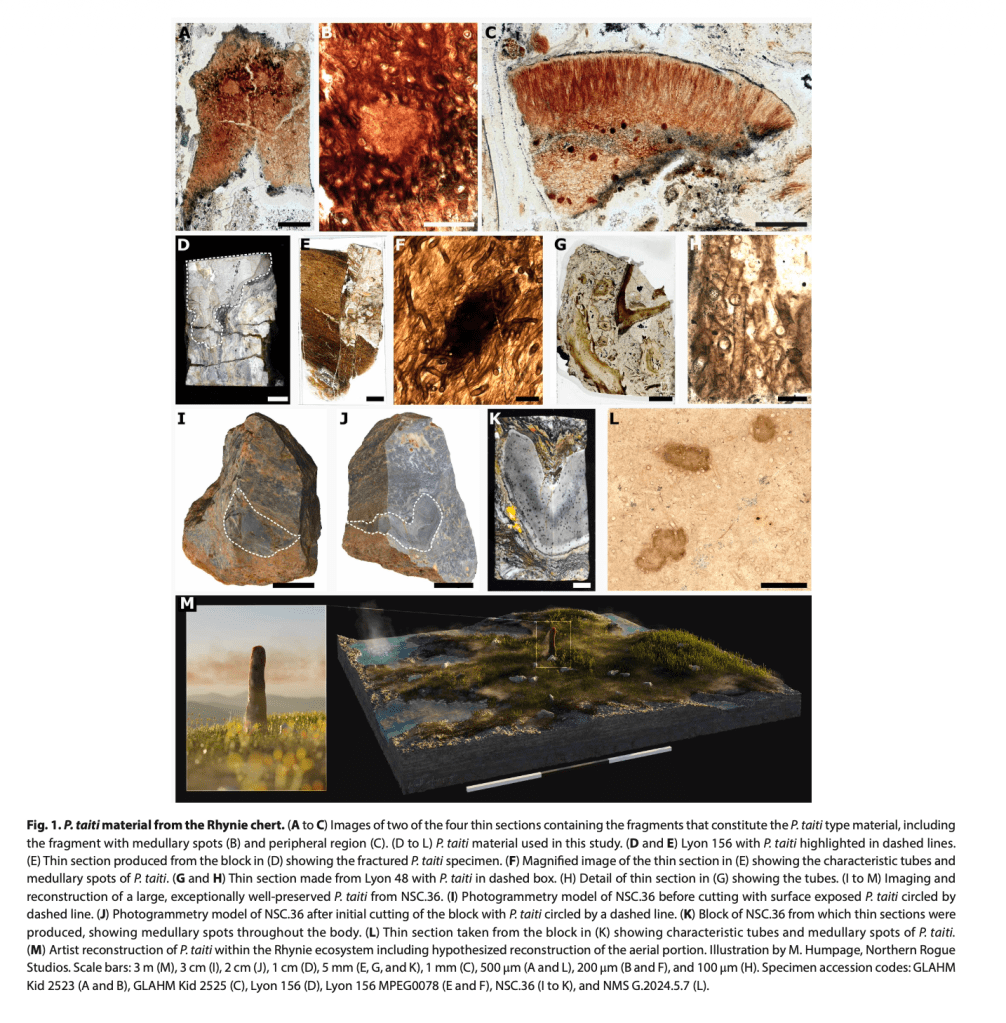
A definitive answer as to what Prototaxis is may remain out of reach for now. But that uncertainty is part of what makes Prototaxites so fascinating. The unexpected discovery of an enormous, mysterious organism that once dominated the landscapes we now inhabit reminds us how strange early life on land truly was, and how much of Earth’s biological history is still waiting to be understood.
References
Loron, C. C., Cooper, L. M., Mcmahon, S., Jordan, S. F., Gromov, A. v, Humpage, M., Rodgers, N., Pichevin, L., Vondracek, H., Alexander, R., Dzul, E. R., Brasier, A. T., Krings, M., & Hetherington, A. J. (2026). Prototaxites fossils are structurally and chemically distinct from extinct and extant Fungi. In Sci. Adv (Vol. 12).
Hobbie, E. A., & Boyce, C. K. (2010). Carbon sources for the palaeozoic giant fungus prototaxites inferred from modern analogues. Proceedings of the Royal Society B: Biological Sciences, 277(1691). https://doi.org/10.1098/rspb.2010.0201
Nelsen, M. P., & Boyce, C. K. (2022). WHAT TO DO WITH PROTOTAXITES? International Journal of Plant Sciences, 183(6). https://doi.org/10.1086/720688

