Autumn is typically the ideal time for mushroom hunting outdoors. The increased precipitation that cools the summer heat allows many organisms to grow and thrive.
But, while autumn steals the spotlight for mushroom hunting, summer offers its own collection of unique fungi. Some species are specifically adapted to summer’s warmth. After a summer storm, you might notice mushrooms popping up overnight. This is no coincidence. Fungi respond quickly to changes in moisture. Their underground mycelium networks wait patiently until the conditions are just right, then push their fruiting bodies above the surface.
Fungi you might find this summer
Chanterelle: These mushrooms are a favorite in the wild, not just because of their gorgeous golden beauty but also for their rich flavor and fragrance. Their fruity aroma is usually compared to apricots. They have a distinct vase or trumpet shape, with wavy caps and false gills. (false gills might be hard to distinguish from true gills. True gills are sharp, blade-like structures you can pull away from the cap, while false gills are just folds in the cap that can’t be easily separated) Chanterelles love damp hardwood forests, especially around oaks, birches, and beeches, where they form symbiotic relationships with tree roots. You’ll usually spot them from mid to late summer, often showing up in abundance after a good stretch of rain.
Check out this link to explore this mushroom more in depth and learn the ID tips!
Boletes: Boletes are easy to spot, because instead of gills, they have a layer of tiny pores on the underside of their cap. Many of the best edible mushrooms belong to this group, including the famous King Bolete (Boletus edulis). Boletes tend to grow with conifer or hardwood trees and love damp forest soil. They are especially abundant in late summer and early fall. Figuring out which ones are good to eat can be tricky, though. While many are safe and tasty, others are bitter, inedible, or mildly toxic. A forager tip: stay away from red-pored boletes and those that bruise blue, as these traits often signal toxicity.
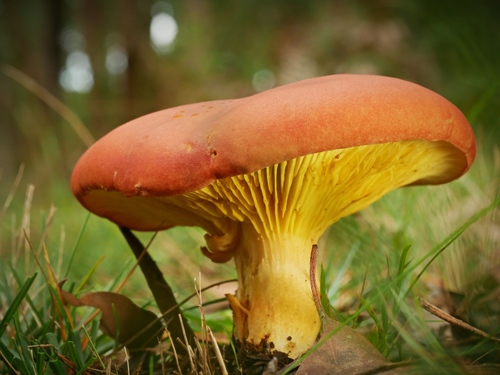
The species Golden Gilled Bolete is a bit a rule-breaker in the family. As you can tell from its name and appearance, Golden Gilled Bolete has gills! You can spot it by its dry, red-brown cap and the bright golden gills that run down its yellowish stem.
To learn how to identify gilled Boletes, check this guide out!
Indigo Milk Cap
The Indigo Milk Cap is one of the most eye-catching mushrooms you can spot in summer. Its cap ranges from silvery blue to deep indigo and often displays concentric circles. Its gills and stem match the same vivid color. What makes it truly unique is the bright blue latex (or “milk”) it exudes when cut or broken. This feature is what gives its name. You’ll usually find Indigo Milk Cap near pine trees from mid summer to early fall. While its striking color can make some foragers hesitate, it’s actually edible (just be sure you’ve got the right ID, since some of its lookalike relatives can be toxic).

Black Trumpet
Among all the mushrooms summer brings, the Black Trumpet might be the most mysterious and the most rewarding to find. Often called the “trumpet of the dead”, it has a thin, funnel-shaped body that blends so well into the forest floor you’ll miss it unless you’re really looking. But once your eyes adjust, you’ll start spotting them everywhere. These elusive mushrooms love mossy, hardwood forests and tend to grow in clusters after a warm rain in late summer.
This mushroom also stands out for its nutritional composition. It is rich in protein, fibers, and vitamins and is an excellent source of antioxidants like ergothioneine and polyphenols. In addition, it contains β-glucans, lectins, terpenoids, phenolics, and sterols, all of which can offer health benefits to consumers. (Interested in reading more? Check out this article)

Hericium Erinaceus

If you’ve ever stumbled upon a white, shaggy mushroom clinging to the side of a tree that looks more like a sea creature than a mushroom, chances are you’ve met the Lion’s Mane (in other words, Hericium erinaceus). But what really sets it apart is its potential to support cognitive health. Studies suggest it may help stimulate nerve growth factor, a compound that plays a crucial role in brain function, memory, and even nerve regeneration. This is not necessarily classified as a summer mushroom. It grows most steadily during fall months, but in areas with cooler, moist conditions, it might start appearing in early August.
Old Man of The Woods: Strobilomyces Strobilaceus

The Old Man of the Woods is easy to recognize thanks to its rugged appearance and dark cap. It usually shows up in mid to late summer, often on the ground near oaks. The cap ranges from gray to almost black, with a dry, cracked surface that really does make it look “old.” Like other boletes, it has pores instead of gills underneath, and these can darken or bruise when you touch them. It is edible, but doesn’t exactly have the most pleasant flavor. When cooked, it tends to turn gray, which can be unappealing to some. (This page can give you more detailed information).
Below are some fungi pictures I captured during my outing last weekend…

This is undeniably a Boletes species. You can clearly see the pores beneath its yellowish cap.

Though I am not an expert in mushroom identification, judging by its orange-red cap and yellowish stem, this is most likely an Amanitas species. Most Amanitas species begin fruiting in late summer through fall, especially in temperate regions. But in warmer climates or different regions, some species might appear earlier in summer, after periods of rain.


It is very common to see fungi growing right next to a tree or on a tree trunk, which indicates a symbiotic relationship between the two. You can see examples of this in pictures right above.


Still not sure what this fungus is. It didn’t have gills, which might suggest that it most likely belongs to the Boletes family.


The one on the far left resembles Cordyceps, the Zombie fungi I made a post about. In temperate forests like the New England region, Cordyceps fruit from June through September. Some species can fruit nearly year-round, but are most active during the wet season. The fungus in the middle might be Ganoderma curtisii, a species that typically fruits during the summer months. It grows attached to a living or dead hardwood tree. And the last one is, of course, the summer’s must-see mushroom: Chicken of the Woods.
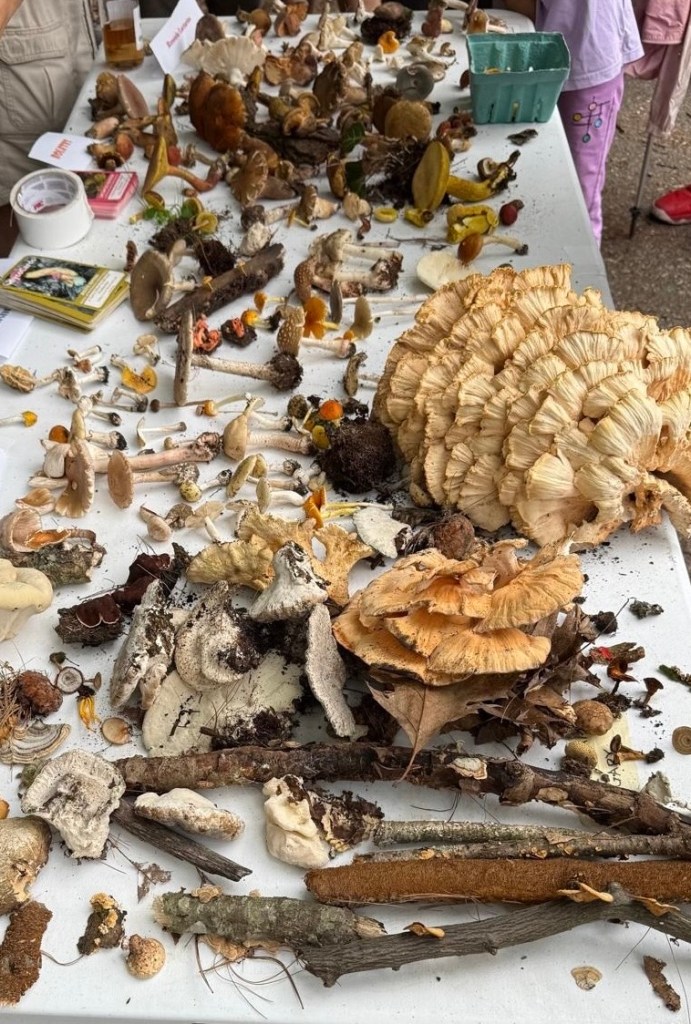
Below is a picture of the whole table
Do you know any other cool summer fungi? Let me know in the comments!
 fungitopia.org
a very informative post on summer fungi and a great shot of Chicken of the Woods! A mushroom species that I keep coming across in the summer is Stropharia rugosoannulata (also known as the wine cap). The nickname comes from its wine-red cap when young, which gradually fades as it matures. I usually spot them on wood chips. I believe they can also be found in gardens and compost piles.
LikeLike
I’m glad you enjoyed reading about summer fungi. Chicken of the Woods is the species I come across most often, though I can’t usually find them in those huge, tightly packed clusters. So, it’s really rewarding to find one as large and impressive as the one in the picture. I haven’t spotted ‘the wine cap’ yet, but I’ll be on the lookout!
LikeLike
Thank you for another fun read! I’ve spotted almost all species you talked about on my past foraging trips, including Amanitas and Boletes. Hoping to find an Indigo Milk Cap soon. Also, just a small note: I believe the fungus you mentioned as possibly ‘Cordyceps’ might actually be Clavulinopsis. Cordyceps usually have a blunt tip.
LikeLike
That’s awesome, you have seen many of them already. And thanks for the ID tip. I just searched it up, and I believe you’re right! It does look like Clavulinopsis. Still working my way toward becoming an ID expert.
LikeLike
Such an informative post! I will keep my eyes peeled for all of these interesting species.
LikeLiked by 1 person
I’m glad you enjoyed the post. I recommend that you look for these fungi after a steady rain. It’s been very dry lately, so it might be hard to spot all of them.
LikeLike